PHFI Injury Prevention Research Centre
We strive to reduce avoidable deaths and disabilities due to injuries. Our mission is to connect research, education, and practice to build safer communities through injury prevention in order to avoid injury deaths and to improve quality of life of those injured.
Injuries are a critical public health priority. Globally, injuries claim more than 4.3 million lives each year, imposing a profound social and economic burden. Low- and middle-income countries bear the greatest share of this burden, where injury prevention is often under-prioritised in public health agendas—despite the availability of cost-effective interventions.
India ranks among the countries with the highest numbers of injury-related deaths and disabilities. The impact is especially severe because many injuries affect children and young adults in their most economically productive years. Preventing injuries not only saves lives but also strengthens India’s demographic and economic potential. However, without robust local evidence, the scale, nature, and solutions to injury risks remain poorly understood. Policymakers often lack timely, reliable, and accessible data to inform prevention strategies—either because the evidence does not yet exist, or it has not been synthesised and communicated in actionable ways.
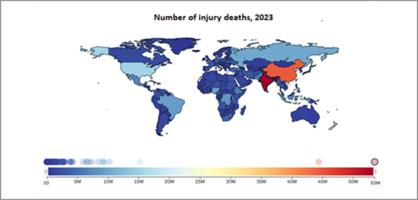
One in 5 injury deaths worldwide were in India worldwide in 2023 (20% of all injury deaths)
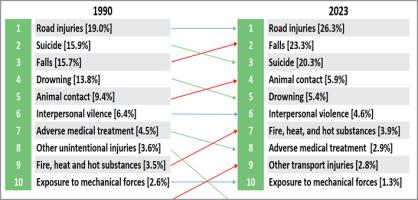
Leading causes of injury deaths in India are road injuries, suicide, and falls
The Centre is established to bridge this gap through scientific excellence, policy relevance, knowledge sharing, and strategic collaborations. We are committed to generating, curating, and communicating the best available evidence on injury patterns, their impacts, and proven prevention strategies—empowering decision-makers to act with confidence and urgency.
Our Work Pillars
Research
We lead research that drives practical solutions to prevent injuries in India and the Global South. Our goal is clear.
- Map the epidemiology and impact of injuries.
- Identify what works to reduce harm and save lives.
While we address a wide range of injuries, we place special emphasis on those often overlooked at the population level:
- Drowning
- Gender-based violence
- Occupational injuries
- Injuries from natural disasters
Every project applies a gender lens, ensuring interventions are tailored to the unique risks and needs of both women and men. Through evidence, insight, and collaboration, we turn research into action—making communities safer and more resilient.
EDUCATION
We are committed to strengthening expertise in injury research and safety promotion in India and across the Global South. Our education initiatives will blend a strong public health perspective with scientific rigour, enriched by real-world examples of challenges and successes from the region.
Our opportunities will include:
- Capacity development programs
- Specialised courses
- Webinars and workshops
We aim to design and deliver an Injury Prevention elective for the Masters of Public Health program, and a comprehensive e-learning program in Injury Prevention tailored to meet the needs of diverse stakeholders. Beyond national engagement, we will explore opportunities to contribute to global injury prevention education through strategic partnerships.
PRACTICE
Addressing injuries in India has been hindered by the absence of a coordinated, multi-sectoral, and multidisciplinary approach. We are committed to changing this by fostering collaboration across diverse fields to influence public policy and practice, ultimately preventing injuries and building safer communities.
We are dedicated to ensuring that research findings are translated into real-world impact. Our practice pillar focuses on applying evidence to design, implement, and evaluate interventions that make communities safer. We will work closely with government agencies, non-governmental organisations, community groups, and other stakeholders to:
- Adapt proven interventions to local contexts.
- Pilot and scale innovative injury prevention strategies.
- Integrate safety promotion into existing health and development programs.
Our approach emphasises co-creation—working alongside communities to ensure that solutions are culturally relevant, feasible, and sustainable. Through targeted projects, technical support, and continuous engagement, we will bridge the gap between research and practice—turning knowledge into action that saves lives and reduces injury burdens.
Explore Our Current Research
SUICIDE PREVENTION AND SUPPORT SERVICES
Funded by: Mariwala Health Initiative
This project attempts to address gaps in the current suicide data by providing a more detailed and nuanced understanding that goes beyond the aggregate figures reported by the National Crime Records Bureau (NCRB). While NCRB data serves as a key resource, its aggregate nature, underreporting particularly among women and lack of individual case-level information limits its utility in shaping suicide prevention strategies.
The MHI-funded research project on Suicide Prevention and Support Services (SPSS) included the analysis of existing suicide death data from the nationally representative survey, a new study concentrating on the underlying reasons for such deaths, and the postvention needs of bereaved families in Uttar Pradesh, Maharashtra, and Tamil Nadu, the three states with a significant number of suicide deaths in the nationally-representative survey. This research aimed to inform the development of effective suicide prevention and postvention strategies and tailored support systems for survivors, through in-depth interviews with bereaved families. Key objectives included identifying the support needs of families coping with suicide loss, family perceptions of mental health and suicide risk, and potential stigma surrounding suicide.
NIHR Global Health Research Group on Violence Against Women and Violence Against Children
Funded by: National Institute for Health care and Research, UK
Lead collaborators University of Birmingham, UK and University of Cape Town, South Africa
Violence against women and children (VAW/C) are human rights violations that affect many women (one in three) and children (around one billion) worldwide. There aren't many other health conditions that affect such a large part of the global population and have such devastating effects on people's well-being and lives. To address VAW/C, there's a group called the Lancet Commission, of which the study applicants are members. The group is made up of policy makers, researchers, and individuals who have experienced violence themselves, many of whom are from low- and middle-income countries (LMICs).
However, to date much of the high-quality evidence in this field is derived from Northern hemisphere high income countries where social structures and available services vary substantially, and as noted by three recent systematic reviews, there is limited data describing the incidence and prevalence of VAW/C as well information for what works to prevent violence in LMICs. In order to address this issue, the Lancet Commission on VAW/C (comprised of policymakers, researchers and those with lived experience, many of whom are based in LMICs was formed. It was established to identify best practice in preventing VAW/C globally and identify the evidence gaps in LMICs.
In this context, this is a multi-country project across five countries (South Africa, Mexico, India, Brazil and Sri Lanka) to coproduce with survivors of VAW/C trauma-informed research to help us understand how we can better prevent violence and build local research capacity.